

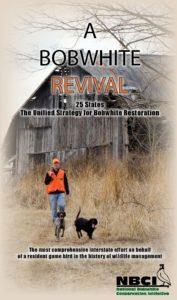
The National Bobwhite Conservation Initiative (NBCI) is the unified strategic effort of 25 state fish and wildlife agencies and various conservation organizations -- all under the umbrella of the National Bobwhite Technical Committee -- to restore wild populations of bobwhite quail in this country to levels comparable to 1980.
The first such effort, in 2002, was a paper-based plan by the Southeastern Quail Study Group under the umbrella of Southeastern Association of Fish & Wildlife Agencies. That plan, termed the Northern Bobwhite Conservation Initiative, attracted considerable attention around the country, including that of the other states in the bobwhite quail range. The result was a broad expansion of the effort and a revision of the plan (and the Southeastern Quail Study Group itself, now the National Bobwhite Technical Committee) to include 25 states in the bobwhite’s range.
Today, NBCI is a multi-faceted initiative characterized by three key elements:
(1) an easily updated, online strategic plan to be released publically in March 2011
(2) a massive and easily updated online Geographic Information System (GIS)-based conservation tool to help state biologists and other conservation planners identify and achieve individual state objectives within the overall national strategy, also scheduled for full release in March 2011. (Over 600 biologists within the bobwhite’s range participated in building this conservation tool.)
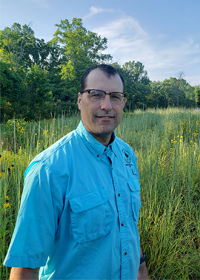
(3) a small team of specialists dedicated to range-wide, policy level efforts to bolster respective state step-down strategies. Click the link to see the NBCI team contact list.
NBCI Team
1. Heritage
Northern bobwhites (Colinus virginianus) are a traditional and valued part of our nation’s cultural, rural, hunting and economic heritage. Widespread restoration of huntable populations of wild quail will have myriad positive societal benefits for individuals and families, rural communities, cultures and economies.
2. Stewardship responsibility
Reversing long-term, widespread population declines of wild bobwhites, associated grassland birds and the native grassland ecosystems in whichthey thrive is an important wildlife conservation objective and an overdue stewardship responsibility.
3. Landscape-scale habitat problem
Long-term, widespread population declines for bobwhites and grassland birds arise predominantly from subtle but significant landscape-scale changes occurring over several decades in how humans use and manage rural land.
4. Working lands habitats
Bobwhites and grassland birds can be increased and sustained on working public and private lands across their range by improving and managing native grassland and early successional habitats, accomplished through modest, voluntary adjustments in how humans manage rural land.
5. Interjurisdictional responsibilities
State wildlife agencies bear legal authority and leadership responsibility for bobwhite conservation, while migratory grassland birds legally are a legal co-responsibility with the federal government; however, the vast majority of actual and potential grassland bird habitats is privately owned.
6. Partnerships and collaboration
Restoration success depends on a comprehensive network of deliberate, vigorous and sustained collaboration with land owners and managers by state, federal and local governments as well as by corporate, non-profit, and individual private conservationists.
7. Strategic approach
Success requires a long-term, range-wide strategic campaign combined with coordinated, effective action at all levels of society and government, to create a public movement to address conservation policy barriers and opportunities that have the needed landscape-scale influences.
8. Adaptive management
Adaptive resource management principles will inform and increase the efficiency of restoration and management and to satisfy multi-resource and multi-species needs.
9. Long-term challenge
Following a half-century of decline, landscape-scale restoration of bobwhite and grassland bird habitats and populations across their range will require determined and sustained conservation leadership, priority, funding and focus for decades to come.